
API Keys
Create forwarding API keys and set limits, groups, and capture options.
What an API key does
Clients authenticate forwarding requests with an API key. Every key starts with sk-. Send the key in one of these headers:
Authorization: Bearer sk-...
# or
x-api-key: sk-...
Requests without a valid key receive HTTP 401.
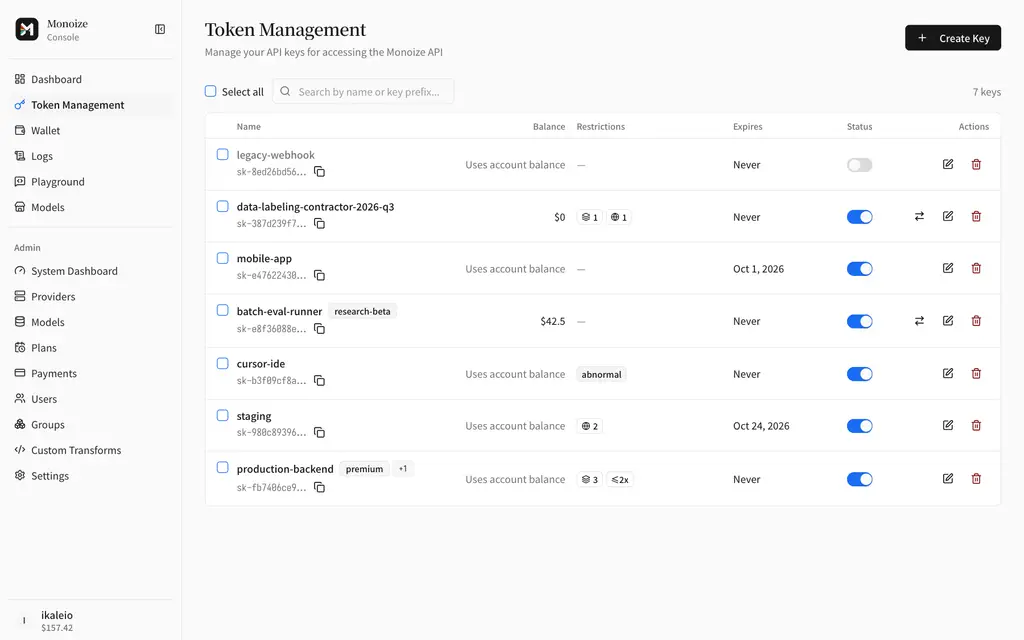
Create a key
- Open Token Management in the sidebar.
- Click the create button and enter a name.
- Set the options you need. All options have safe defaults.
- Copy the full key. The list shows the full key again later; keys are not write-only in Monoize.
Find a key
Type text in the search box above the list. The list shows only the keys whose name or key prefix contains that text. Select all selects only the keys that the list shows.
Key options
| Option | Effect | Default |
|---|---|---|
| Expiry | The key stops working after the expiry date. | No expiry |
| Enabled | A disabled key fails authentication at once. | Enabled |
| Model limits | When on, the key can call only the listed model patterns. | Off |
| IP whitelist | When set, requests must come from a listed IPv4/IPv6 address or CIDR range. | Empty |
| Groups | The key routes only to Providers whose groups intersect the key's groups. | Inherit the user's group |
| Max multiplier | The key skips Channel model entries whose price multiplier exceeds this value. | No cap |
| Sub-account balance | When on, the key spends its own balance instead of the user balance. | Off |
| Request capture | off, capture-all, or capture-only-abnormal. See Request Logs. | off |
| Capture retention | How long captures for this key stay on disk: 5m, 1h, 24h, or 7d. Shown when capture is not off. | 24h |
Model limits
Model limit entries are exact logical model names. A request whose model equals no entry receives HTTP 403 with code model_not_allowed.
Model redirects
A key can hold an ordered list of model redirect rules. Each rule has:
pattern: a regular expression. Monoize anchors it as^(pattern)$against the full model name.replace: the literal target model name.
The first matching rule rewrites the model before routing, billing, and model-limit checks. Key rules run before global rules. Use redirects to move traffic to a new model without client changes.
Groups
- Inherit user group (default): the key follows the owning user's group.
- Explicit groups: select one or more groups. Order matters; Monoize prefers Providers from earlier groups. See Routing and Reliability.
An active subscription limits both modes to the subscription's groups. Selecting another group cannot expand this limit. Subscription changes apply to the next request. Without an active subscription, the key's groups apply.
Per-key transforms
A key can hold an ordered transform chain. Key transforms run inside a safety boundary: only transform types allowed at API-key scope are accepted. See Transforms.